The Cognitive Science Of Teaching and Learning
Unit Four:
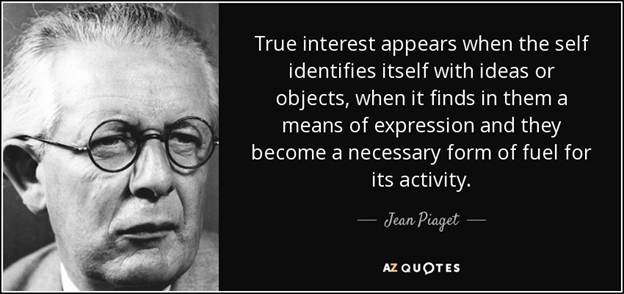
Piaget was an educational theorist who believed in the ability to learn through the acts of play. One form of play in which a student can develop the use of information is the form of Game-based learning. Game-based learning is the action in which travers will supply the students with materials to allow each student with the opportunity to implement problem solving on their own through objectives or games placed before them (Game Learn, N.D.).
Using games in learning gives students pleasure in the act of having fun playing a game while learning content that is presented to them. The use of game-based learning helps keep students engaged, motivated, with the thought of actively progressing with the use of the understanding of topics. This also allows student’s to set goals for themselves. The use of alternative strategies through play helps the learner actively move through a set of problems developed with-in a game and complete the given task ( University Of Toronto Libraries,2021).
As a paraprofessional get to actively watch a teacher implement game-based learning, whether it be based off of technology, or hands on games, the students are learning through the use of games. One teacher I have work with the past few years took advantage on this form of learning in her math class often. She used competitive games allowing students to work together to use combined knowledge in order to beat her in a game, or work more independently against a classmate. No matter what she used as her games, you can see these fourth-grade students work hands on to develop their own knowledge on a topic through the act of having fun. Having fun is a huge part of learning in my mind, yes we can supply our students with all the bookwork needed on a topic, but allowing them to have fun creates the ability to increase memory on the topic through trail and error. Game- Based learning allows the students to not only to learn by winning, but also the use of their memory on remembrance of their errors so they try not to use that tactic again. Game-based instruction gives the students an easier way to motivate and take ownership of their own education. This provides the students the encouragement to understand a lesson in more of a self-directed nature.
Game Learn, N.D. The Theory Of Game-Based Learning. Retrieved from https://www.game-learn.com/the-theory-of-game-based-learning/
University Of Toronto, 2021. Digital Pedagogy- A Guide For Librarians, Faculty, And Students. Retrieved from https://guides.library.utoronto.ca/c.php?g=448614&p=3505475

Unit Five:
Motivation or the action in which one is internally affected to provide us with a certain form of direction which will engage students on a personal level encouraging them to work their hardest based off individual aspects (Schreiber,2016). The use of motivation is seen daily whether it be inflicted by us, or through another’s encouragement.
Motivation can occur in all aspects of our lives whether its id in education or our daily lives. When I suffered my stroke, I was unable to walk, I fought hard daily to set goals for myself to walk a set amount a day and increase the amount daily I was motivated to work harder to complete my internal goals.
Working as a paraprofessional one of my main jobs is to encourage my students to try their best. This past year I had a child with behavior problems, I used the action of rewards to motivate the child to participate good behavior. For example, he had a behavior chart and took a liking to a videogame called Among us, I told the student if we went a whole week with no sad faces for poor behavior and received all smiles for good appropriate actions and stars (exceeding expectations), he would receive a package of these stickers, after about two weeks of trying this student changed his behavior around completely in order to earn his reward. This was a form of external motivation.
By the use of motivation, we are push one another or even ourselves to try and become better at something by trying ( Perkins,2009). Using encouragement an individual is given the tools mentally to overcome an obstacle to complete a given task.
Perkins David,2009. Making Learning Whole: Seven Principals Of Teaching Can Transform Education. Retrieved from https://eds-a-ebscohost-com.postu.idm.oclc.org/eds/ebookviewer/ebook?sid=a040d18e-9a9d-421f-bf8e-f7fc48d957be%40sdc-v-sessmgr02&ppid=pp_C1&vid=0&format=EB
Schreiber James B.,2016. The Psych 101 Series: Motivation. Retrieved from https://eds-a-ebscohost-com.postu.idm.oclc.org/eds/ebookviewer/ebook/bmxlYmtfXzE0MzYyNjVfX0FO0?sid=74a0cc9d-3cbc-4b03-b671-438d362d95fd@sdc-v-sessmgr02&vid=2&format=EB&rid=5
Unit Seven:
Social context is very important in a child’s learning not every student learns intake information the same way so allowing learning to be based on instruction solely off a teacher’s direction. As instructors we need to take a step back while delivering our lesson and look at the student’s individual needs rather than solely the lesson. To do this we need to open the opportunity for self-directed learning by give the student choices provides the individual to take control of their own learning . Taking control of your own learning gives student’s power of choice and ability to take the given information and present it to themselves and others in a form which helps the student retain the information. (Draeger & Wilson, 2016).
Giving someone an opportunity to choose how they work on a lesson, will become beneficial for memory, when given the choice of something, you usually go with the option that most interests you and holds your attention, if we allow a student to choose how they use the knowledge given to them, they will choose. Whether this means allowing your students to choose a book they would like to read, during a fiction lesson, picking a partner for a math game, choosing a game themselves or a center to play in based on their age and ability, you are providing students the ability to choose their learning and method of being taught a lesson. This goes for all ages; I feel the younger our students if we allow them to choose their own form on play, we are setting the foundation on taking control of their own learning.
Taking
Draeger,Scott & Wilson, Daniel, 2016. How To Give Student’s More Control Of Their Learning. Retrieved from https://www.edweek.org/teaching-learning/opinion-how-to-give-students-more-control-over-their-learning/2016/03
 Notes From Miss. Conforti's Desk