Differentiated Learning
Unit one:
Unit One Blog:
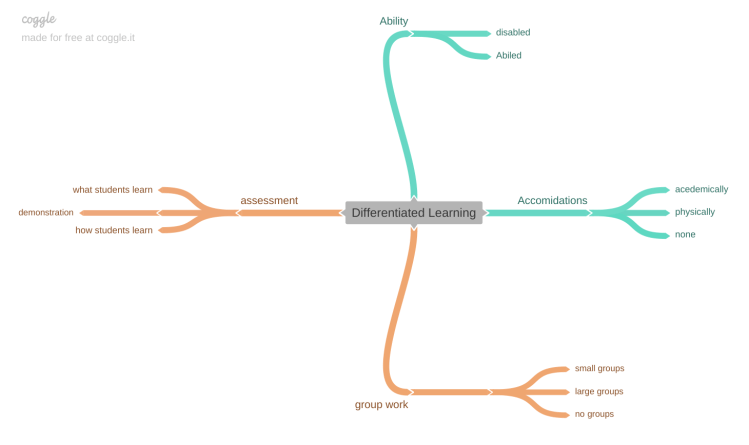
When I first started this class, Viewed differentiated learning as the instruction of individuals with all abilities, whether it be abled or disabled. Disability both physically or cognitively. We need to make certain accommodations to help learners reach their full potential. No student learns the same way so as educators, we need to adjust our teaching strategies to accommodate all individuals. Physically disabled students may require more of a classroom setting accommodation, such as higher table and desks or even sitting closer to the board. Being cognitively disability like myself, I have needed extra accommodations such as extra time on assignments or even a one to one tutor.
As I read through the course material, I have learned that some assessments need to be based on both two important factors how a student learns and what the student has to learn. I also learned we need to help a student with groupwork. Groupworks can be found on three opportunities, small groups with only a few students, large groups with many more students, or no group settings. We need to take the time to determine how a learner’s ability can affect these areas and what we can do to assist all students (Tomlinson, 2001).
When teaching a child, we need to keep their abilities and disabilities in mind when implementing curriculum(Castaneda,2012).I would explain differentiated instruction to an educator by stated the fact we want all students to be successful. No individual learns the same way as another, so we need to adjust our instruction to better suit personal-learning strengths, not their weakness. Explaining differentiated learning to a someone may be challenging because one may not understand the accommodations being made for them is to help them succeed by using other forms of instruction to assist the student in accomplishing their goals as a learner.
Castaneda Roxanna,2012).Differentiated Instruction. Retrieved from https://www.youtube.com/watch?v=bApuBiitL8Q
Tomlinson Carol Ann,2001. How To Differentiate Instruction In Mixed Ability Classroom 2nd Edition. Retrieved from https://ebookcentral-proquest-com.postu.idm.oclc.org/lib/post/reader.action?docID=280341&ppg=10
Unit Two: Journal Review:
The article I chose to read was “Differentiated Instruction: Understanding and Applying Interactive Strategies To Meet The Needs of All Students” which was written by Hatixhe Ismajli. This article was written to help teachers discover new methods of teaching for alternative learning students. The research was done on 200 students and parents with 30 teachers within a mix of public and alternative schooling. The student was done considering that not all students learn the same way at the same speed. The article states how expecting a student to learn the same way as others in the group is impossible, whether you group students with the same abilities or group them with different abilities.
The participants were asked four questions on how they felt about the differentiated instruction affecting the students’ need to become successful despite their abilities. One question given to students was the best form of expression used in the classroom between: group work, written test, in-class per performance, essays, and discussions., roughly 3.54% of the participants chose not to respond. Between the two forms of schools, 5.42% of students preferred group work, while 16.88% preferred written tests. 24.5% was in-class performance, 8.75% were interested in showing their abilities in an essay form. Other questions such as In-class learning activities bring helpful, as well as forms of work preferred, and instructors’ clarity were all used. The second question was based on how active a learner is in class learning activities. According to the results, 66.67% of students believed that they always participate while in the often category 22.29% believed they did. Lastly, only 11.04% of students believed they only participated sometimes. The third question was based on how the individual student preferred to work and 7.29% of the participants preferred to work alone. 44.38% liked to work in pairs while 4.38% stated it would depend on the work at hand. The last question was based on how the students felt the clarity of instructions were given. 67.29% of participants felt the instructions were always clear, 14.38% felt they were almost always clear where 10.62% of students felt they were sometimes clear. I was shocked to see only 6.87% believed this question could vary due to the instructor, I would have assumed the number be much higher. The last section of this question was the students who felt instructions were not given clearly, 0.84% were in favor (Ismajli,2018).
This article was remarkably interesting to me because it talks about being someone with difficulties in schooling, as well as teaching student’s clarity on assignments. Allowing inclusion in the classroom turned out to have higher percentages than those students in classrooms which is strictly based on their abilities. One the first chart given on how a student felt is the best form of expression, I feel my in- class performance would speak highly of me. However, after speaking to another peer of mind with their own difficulty, they felt written tests would be better. I feel that is why you see such a mix of instruction in the classroom, it is to better prepare each individual with the ability to learn and succeed.
Ismajli, H.(2018). Differentiated Instruction: Understanding And Applying Interactive Strategies To Meet The Needs Of All Students. Retrieved from
Unit 3 Blog:
I believe differentiated learning is not only difficult for the teachers but the students themselves. As teachers we must take into consideration how not one student learns the same as another and may need accommodations to help them become successful. Being a differentiated learner myself I have run into many problems being successful just due to the fact of not understanding assignments fully which in turn makes me run out of time, so I rush to get assignments done. One strategy I like as a learner is having a professor really trying to actively trying to get to know me, such as communication journal, but since we are based solely online communication through email works the same(Tomlinson,2001).If you get to know your students based on who they are personally and not just who they are on paper, I feel you can become knowledgeable on what they may need from you, as they can figure out what you need from them. Another strategy as a differentiate learner I find most valuable is having time for self-reflections on what I’d like to learn then be able to reflect if this was accomplished (Channel,N.D). I feel if I can set my own goals on what I expect to learn from a class then when I’m finished reflect on what or how I did, I will learn more for next time.
Channel, N.D. Socratic Seminar: Patience And Practice. Retrieved from https://learn.teachingchannel.com/video/bring-socratic-seminars-to-the-classroom
Tomlinson Carol Ann,2001. How To Differentiate Instruction In Mixed Ability Classrooms: 2nd Edition. Retrieved from https://ebookcentral-proquest-com.postu.idm.oclc.org/lib/post/reader.action?docID=280341&ppg=10
Unit Four:
One especially important teaching strategy in a differentiated learning setting is the small- group instruction. I chose to research this form of instruction to broaden my scope on my path to become a teacher, being a paraprofessional, I work with my own small group daily. But, if there is no extra help for the teacher in the classroom, how can one work with all students at different times? This is when a classroom broken into small groups comes in handy. According to this video, you can see students learning alongside their peers or individually while the teacher is giving his or her undivided attention to one small group at a time.
In small group instruction, a teacher separates students based on their academic learning levels, then the teacher takes turns with each group on a specific lesson. While the teacher is working with one group the students will work on other activities or alternate lessons for other small groups to rotate through. This allows the teacher to give undivided attention to a group of five or six students to make sure they understand the topic at hand. While working with your group you must set up stations to help other small groups work together to complete assignments such as computer time with instructional materials such as IXL or Prodigy for math, Lexia for reading. You may also use games such as fraction bingo, or peer reviewing on an assignment such as a writing component, anything that can expand one’s knowledge with other peers on the same educational level (Thain, 2016).
Thain Kyle,2016. Small Group Instruction. Retrieved from https://www.youtube.com/watch?v=SNfi9-1c85A
Unit 5:
I feel connected more to Gardeners’ theory of Multiple Intelligences. In this theory, Gardener discusses how as learners we learn differently than others, such as becoming visual, personal, musical, mathematical, or verbal learners. Visual learners, learn best from watching a lesson, while verbal is more of discussions or listening to the topic, personal learners learn through experience and make connections, while musical learners work through music and rhyme, lastly mathematical learners study academically through numbers (Waggoner, 2002).As professionals we need to keep this in mind while creating our lesson plans and make sure we are not gearing our instruction to one form of learning. I find myself to be more of a personal or experience driven learner, if I can connect to an assignment through past experiences I seem to do better, while my friend was more of a visual and hands on learner who had learned better through working through an assignment by watching and repeating.
I believe this theory connects with Bernice McCarthy’s 4MAT learning model. McCarthy believed as students we learn through the way we perceive a topic as well as how we process the information (McCarthy,2010).Like Gardener, McCarthy believed individuals learned in different ways, in her 4MAT theory breaks an individual learning methods into 8 stages. One I agree I follow is her stage one phase. Like Gardener’s multiple intelligences theory as I a personal experience learner are learner through my experiences.
McCarthy Bernice, 2010. Introduction to 4Mat By Bernice McCarthy. Retrieved from https://www.youtube.com/watch?v=cpqQ5wUXph4
Waggoner Jan.2002. Multiple Intelligence Meets Bloom’s Taxonomy. Retrieved from http://eds.b.ebscohost.com.postu.idm.oclc.org/eds/pdfviewer/pdfviewer?vid=1&sid=36b156ee-1cc7-4bd0-8b37-1ea23c534348%40sessionmgr101
Unit Six:
While teaching a differentiated classroom there are many steps while creating a curriculum, such as the instruction based on content, process, and product.Content is the step in which an instructor delivers the topic or lesson. This may come in many forms such as visual auditory or technological. The process step is how an individual takes in or understands the content. Finally, it is the product or the result of a lesson (Tomlinson,2001).
As a paraprofessional, I have not physically implemented a lesson based on this instruction. However, I have had the opportunity to witness this instruction in action. One lesson that stands out to me was in a fourth grade L.A. classroom. Here the teacher was instructing the students on how to write opinion essays. She first delivered the content in the form of a instruction based off her own opinion essay as well as went over how to construct an essay using a planning web. This was her content step. Next came the students processing of the information, or how they understand the content. She did this by making a classroom essay where the students worked along with one another in a classroom discussion to construct an opinion essay based on the given topic. Lastly, was the product step. in this step the teacher assigned each student with ideas for a topic such as “What is my favorite season,”. The classroom then worked independently to create their own essay or finished product. I had found this lesson extremely helpful in understanding the content, process, and product topic.
When I deliver the content of a lesson, I believe that I would present the content verbally. This is because I feel that as I go through my lesson, it will be easier and convenient for me to stop and explain something more in depth as the students work on their processing technique to create a finished product. So as student is, we use these steps every day. For example, our blog posts. We are given the content through instruction., we then try to process our information through our readings. Finally, we complete our blogs to create our final assignment, to show our understanding of the content.
Tomlinson Carol Anne, 2001. How To Differentiate Instruction In A Mixed Ability Classroom: 2nd Edition. Retrieved from https://ebookcentral-proquest-com.postu.idm.oclc.org/lib/post/reader.action?docID=280341&ppg=81
Unit Seven:
The article I chose to read was Critical Issues in the Education of Students With Learning Disabilities in the Era of Tiered Instruction: Introduction to the Special Issue. This article caught my eye being the fact I have cognitive disabilities, as well as working with students with multiple disabilities. In this article, the author stated that about 70% of students in a special education program spends 80% of their day in the mainstream classrooms Some families have stated having a child with disabilities in the classroom with non-disabled students suffer from receiving the proper help needed. The author believes in three tiers of instruction three being the help most needed sages’ tone and two show the least and average academy. Once a student can academically move through stages two and three the student manages to be part of tier one which requires the least amount of additional help academically or removing the special education intervention. These tiers are meant to create the opportunity for success in the special education interventions. According to special education experts the implementation of tiered instruction has helped students greatly in success in a mainstream classroom (Obrien,2018). This author feels the need for research-based intervention, difficulties withing students learning the English language, individualized learning plans may benefit from the tiered differentiated instructional models. Without a tiered instruction the author mentions the instructional tiered model moves negatively to a discrepancy model, or as the author states, a “wait to fail,” method of learning. This is when there is exclusion due to the fact the students are expected or set up instructionally to do poorly based off the need of differentiated instruction. In 2004, the IDEA model changed from discrepancy model to the responsive instructional learning in order to have one benefited from intervention within the tiered instruction in a general education classroom. Although tiered instruction in a inclusion classroom can better benefit a student’s needs, the author finds still supplying students with special education services outside a class will be beneficial (O’Brien, 2018).
In my position on working with students with multiple different disabilities, I spend a lot of my day in the general education classroom with these students who receive special education services however out of a 6.5 hours a day they only receive intervention out of the classroom for roughly 30 minutes a day, this accounts for most of the child’s learning done in a mainstream classroom, with accommodations or specific terms in the teachers instruction. I feel including these students in a mainstream classroom is very beneficial for inclusion and the need of acceptancy however, I can see the lack of services they children are missing out on that they may benefit from within the special education platform.
O’Brien,2018. Critical Issues in the Education of Students With Learning Disabilities in the Era of Tiered Instruction: Introduction to the Special Issue. retrieved from http://eds.a.ebscohost.com.postu.idm.oclc.org/eds/detail/detail?vid=3&sid=9797252d-aa02-45b1-b873-537b11eb3f4a%40sdc-v-sessmgr02&bdata=JnNpdGU9ZWRzLWxpdmUmc2NvcGU9c2l0ZQ%3d%3d#AN=134172428&db=eue
Unit 8:
In this class I learned a lot on the instruction in a differentiated classroom, such as readiness and the content-process-product method. Each student learns differently but they all have a common goal, to become a successful learner to do this, we may need to make accommodations or tiered lesson plans, for all our leveled learners. In my differentiated lesson plan, I chose to do a fourth-grade writing assignment. Students are supposed to come up with their own creative writing piece. To do this the use of content-process-product comes to use. I will supply the students with directions and explanations to our lesson, and work on a pre-quick-write- activity to help the students come up with ideas on their assignment, next the students will use the content which was given to them through instruction or activity to help develop a creative piece. Finally, is the students individual finished piece of work, here the students will take their work and share with other students for a peer review.
Working on this weeks project was very helpful to me in my career goals, I was able to use many tools to develop a lesson which can be suitable for all students on different academic tiers. As a differentiated learner myself this project helped me develop an understanding on the way teachers instruct someone like myself and how helpful the tiered instruction is on these learners.
 Notes From Miss. Conforti's Desk